
1. Volume: how much you really have
Pile it, or picture it piled, and measure. Cubic yards = length × width × height in feet ÷ 27, because a cubic yard is 3 × 3 × 3 ft. Round piles are cones: π × radius² × height ÷ 3.
Example: a heap 14 ft long, 7 ft wide and 3½ ft high is 14 × 7 × 3.5 ÷ 27 = 12.7 cubic yards. With our 10% margin that's 14 yd³, so the 15 Yard Dumpster.
Why a margin? Loose debris doesn't pack like a measured box, and the top of the bin is a hard limit: the rate sheet says "Overfilled dumpster (above the red line): additional charges may apply." Our calculators hold back 10% when they match a heap to a bin, and flag the next size up when an estimate fills more than 85% of one. Both are our rules of thumb, shown in the arithmetic.
Can't pile it yet? Estimate from the job instead. The dumpster size calculator turns square feet of drywall, flooring or deck, feet of cabinets, or rooms of junk into cubic yards, and says which numbers are published and which are working estimates. For piles you can measure, use the cubic yard calculator.
2. Weight: the check that sets the price
Every bin from 12 to 25 yards includes 3 tons; the 40 includes 5. A bigger bin in that range doesn't buy more weight: it's $650 and 3 tons whichever you pick. So once you know the volume, weigh it.
| Material | lb per loose yd³ | Source |
|---|---|---|
| Household junk / mixed trash | 300 | High end of EPA’s 250–300 lb for uncompacted mixed MSW (from the Caterpillar Performance Handbook). |
| Lumber / wood (framing, decking, fencing) | 169 | EPA’s factor, the same for clean, painted/stained and treated lumber. |
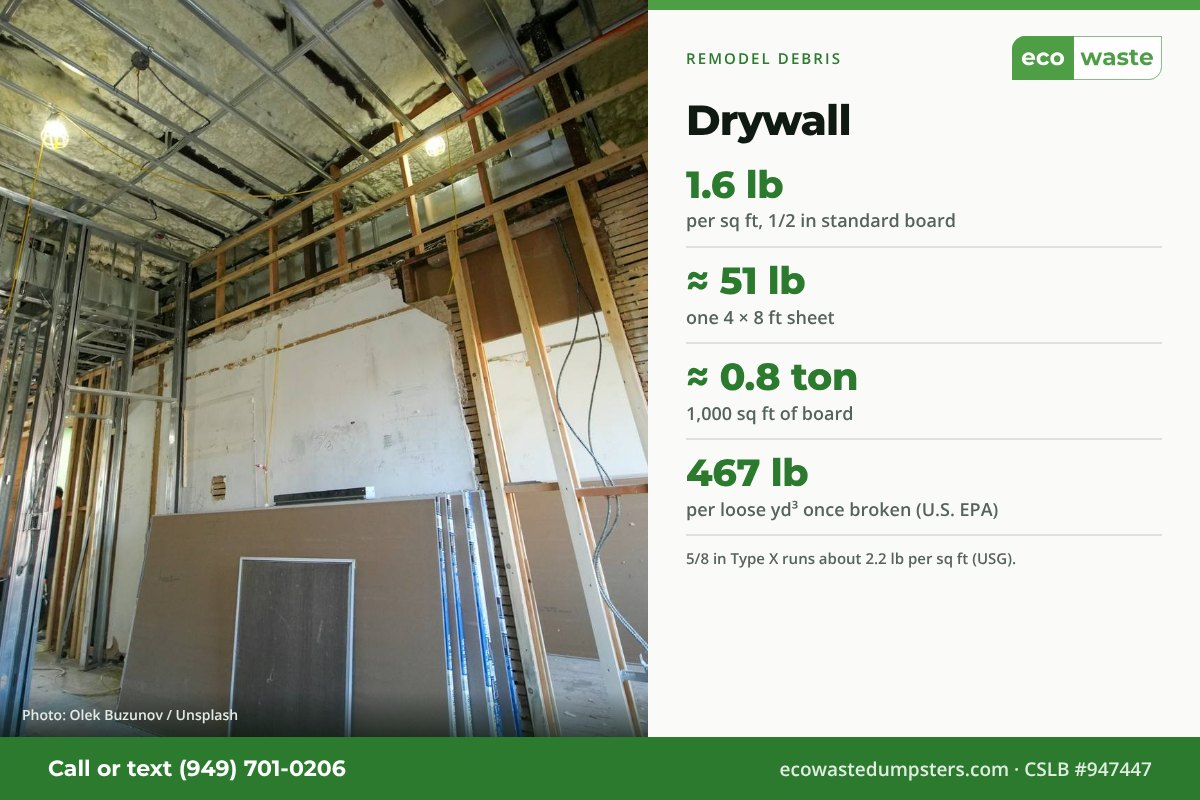
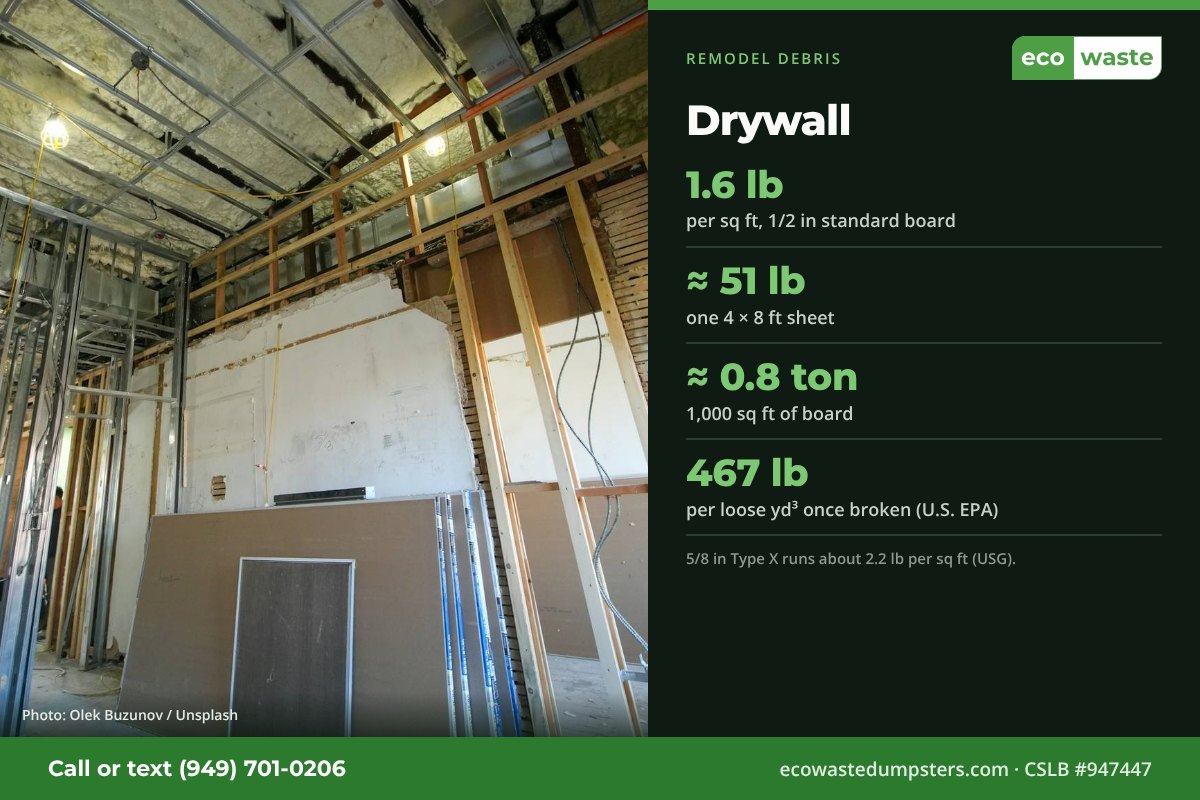
| Drywall / gypsum board (broken) | 467 | EPA’s factor, the same for clean and painted/demolition gypsum. |
| Mixed remodel / construction debris | 484 | EPA’s “Construction & Demolition Bulk” factor (from Florida DEP). |
| Asphalt shingles (composition roofing) | 731 | EPA’s factor. San Diego’s is 40% lower. |
| Mixed yard waste, loose | 250 | EPA’s factor for uncompacted mixed yard waste (EPA gives 640 lb once compacted). |
| Concrete, broken | 2,400 | San Diego’s figure for broken concrete. EPA’s 860 lb comes from a 2006 California study of mixed C&D loads that were characterized visually; for a load that is only concrete we use the heavier published figure. |
| Dirt / soil, dry | 2,200 | High end of the U.S. Army’s 1,900–2,200 lb for loose dry earth. EPA’s 929 lb (dirt and sand) comes from the same 2006 study of mixed C&D loads. |
Full list, with every published figure side by side: debris weight calculator.
Light jobs pass easily. 1,000 sq ft of 1/2-inch drywall is about 1,600 lb (1.6 lb per sq ft, City of San Diego), or 0.8 tons in 3.4 loose cubic yards.
Dense jobs don't. A 15-yard filled with asphalt shingles is about 5.5 tons at the EPA's 731 lb per cubic yard. That rounds to 5 tons, 2 over, for $920.
How the overage is counted
Extra tonnage is rounded to the nearest ton, then billed at $135 per ton. 3.4 tons in a 12-yard rounds to 3: no extra. 3.5 rounds to 4: one extra ton, $135.
3. Space: where the bin will sit
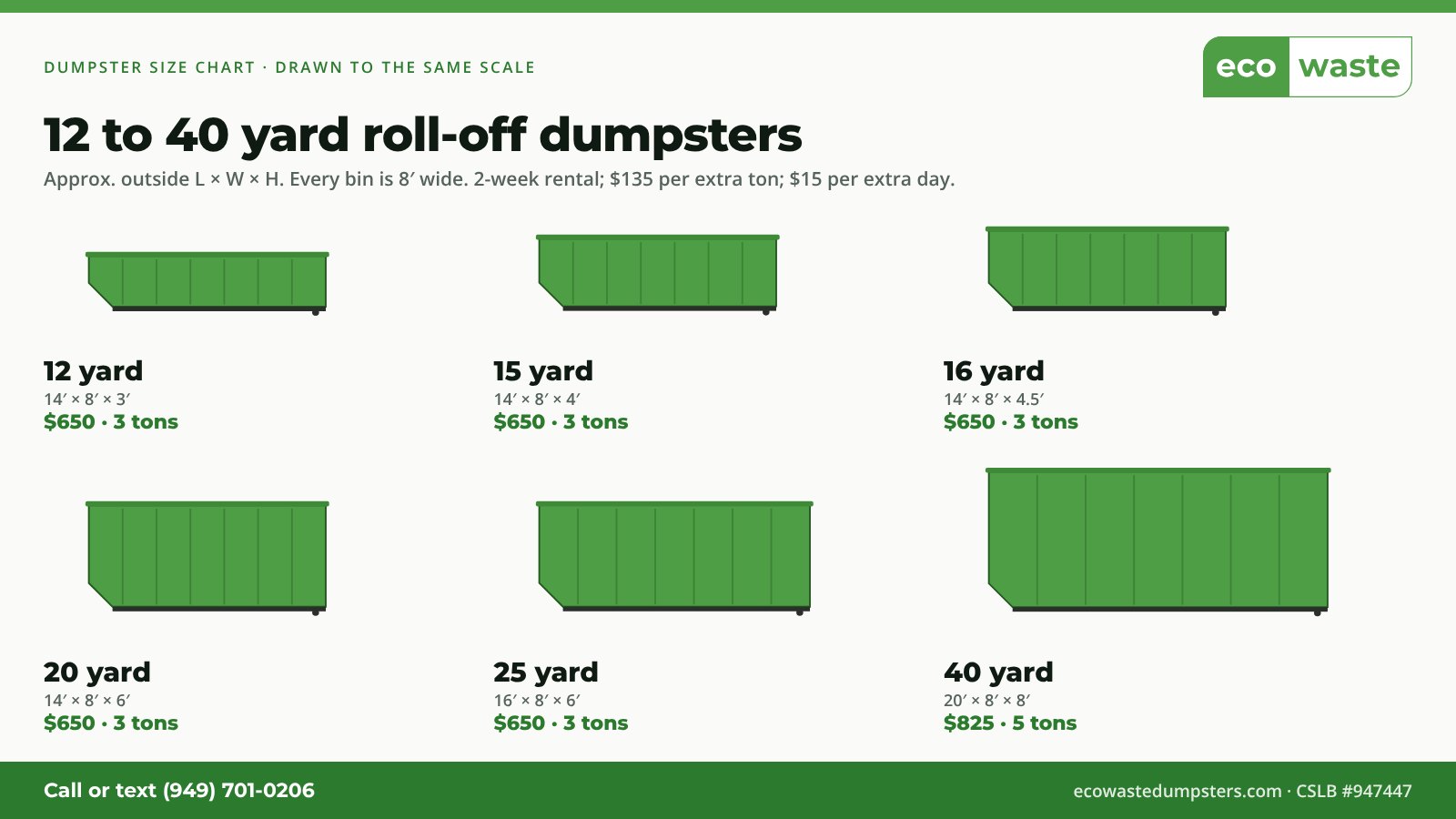
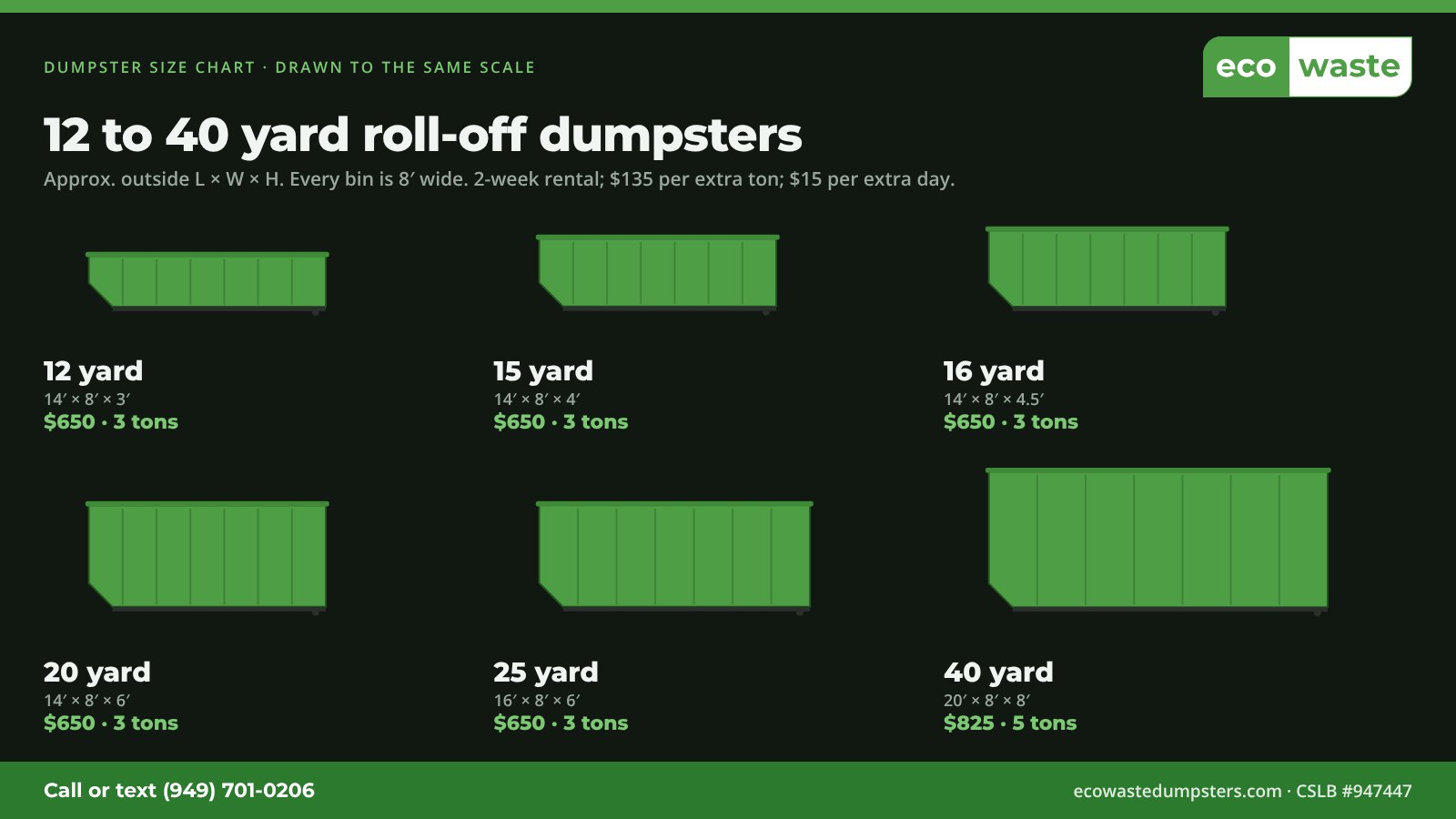
All our bins are 8 ft wide. The 12, 15, 16 and 20-yard are about 14 ft long; the 25 is about 16 ft; the 40 is about 20 ft. If two sizes hold your volume, the shorter one is easier to place.
Measure the spot, including room to open the rear door and walk around it: the driveway fit checker does the arithmetic. If the bin has to go on the street, check what your city requires with the dumpster permit checker. For overhead wires, low branches and tight gates, ask us before delivery day.
Worked examples
These run the same code as the size calculator. Cabinet, clean-out and deck-framing volumes are working estimates, labelled as such in the tool.
| Job | What's coming out | Volume | Weight | Bin | Weight check |
|---|---|---|---|---|---|
| Kitchen remodel | 20 ft of cabinets, 30 sq ft stone top, 150 sq ft tile floor | 6.7 yd³ | 1.3 t | 12-yard | passes |
| Bathroom remodel | tile floor and walls, 100 sq ft drywall, vanity, cast-iron tub | 2.1 yd³ | 0.58 t | 12-yard | passes |
| Carpet tear-out | 800 sq ft, carpet and pad | 8.7 yd³ | 0.5 t | 12-yard | passes |
| Drywall tear-out | 1,000 sq ft of 1/2 in | 3.4 yd³ | 0.8 t | 12-yard | passes |
| Deck removal | 300 sq ft Douglas-fir | 10.4 yd³ | 0.88 t | 12-yard (or 15) | passes |
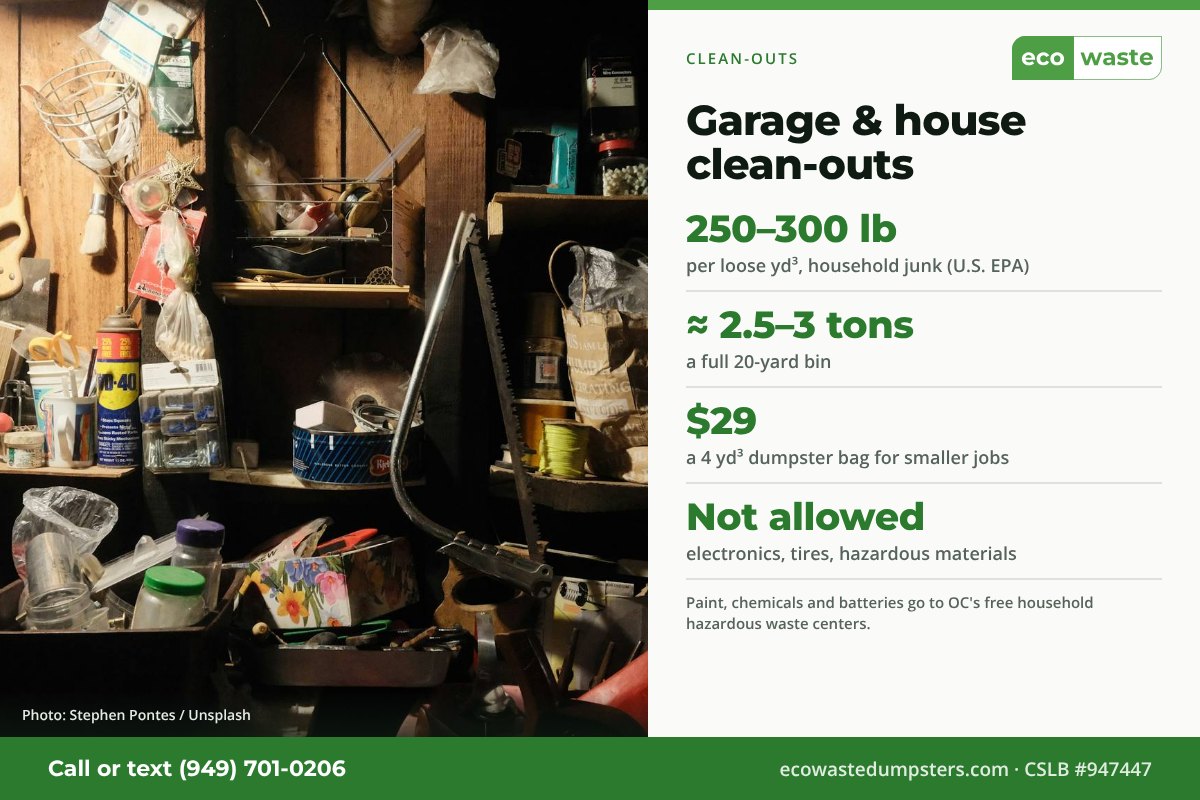
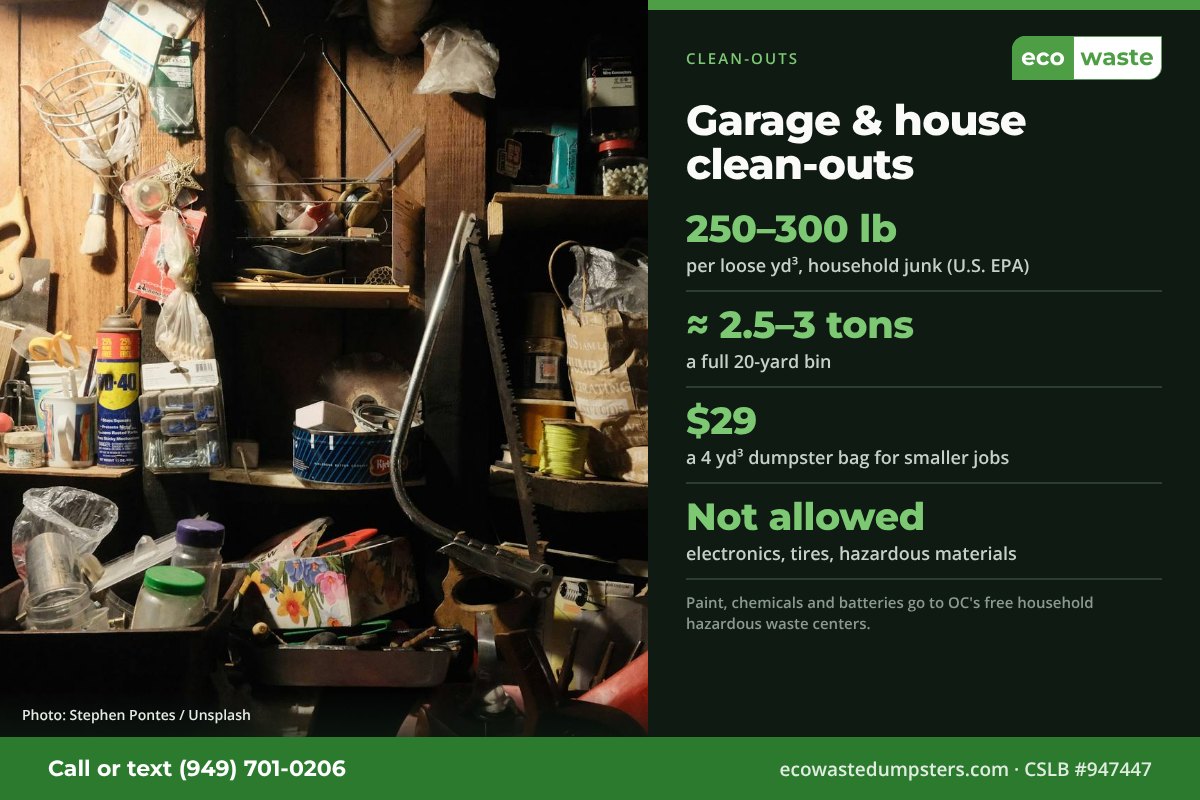
| House clean-out | 3 rooms and a 1-car garage, typical | 13 yd³ | 1.95 t | 15-yard (or 16) | passes |
| Yard clean-up | a 12 × 8 × 4 ft pile of mixed yard waste | 14.2 yd³ | 1.78 t | 15-yard (or 16) | passes |
"Or" is the next size up, shown when the estimate fills more than 85% of the bin. Small loads under 4 yd³ and 2,000 lb also fit a $29 Dumpster Bag.
One big bin or two smaller ones?
Past 25 yards, compare a 40 with two smaller bins. Thirty cubic yards of mixed remodel debris weighs about 7.26 tons at the EPA's 484 lb per cubic yard. One 40-yard: $1,095 (2 t over). Two 15-yards: $1,570. Here the 40 wins, because it includes 5 tons for one base price.
Heavy material is the exception. Concrete, dirt and brick aren't priced in the 40 at all, and they do best in their own bin: clean concrete is $775 flat to the 10 yd³ fill line.
The mistakes that cost the most
- Mixing concrete into a debris bin. "Any debris/trash combined in a dumpster with dirt, concrete, brick or green waste will be weighed and billed at debris/trash rates." Eight yards of broken concrete plus two of remodel debris is about 10.1 tons: $1,595 in a 12-yard, against $775 for the concrete alone in a clean bin.
- Filling past the top. Overfilled dumpster (above the red line): additional charges may apply.
- Sizing by volume and forgetting weight. Roofing, tile and stone are small and heavy. Run them through the weight check.
- Loading what isn't allowed. No electronics, tires or hazardous materials. See what goes in a dumpster.