
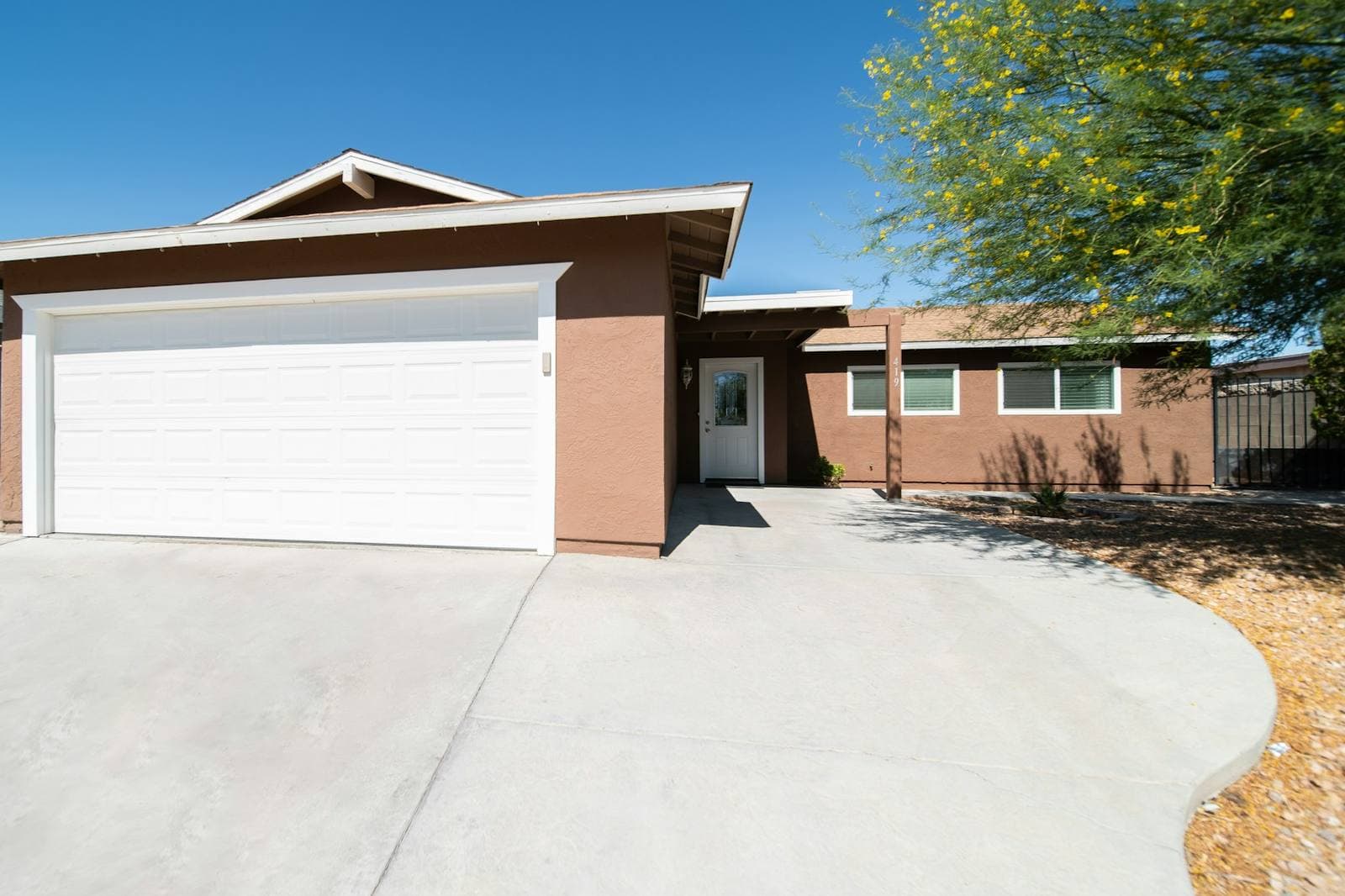
Driveway, lawn or street
There are three places a roll-off usually goes at a house, and the driveway wins most of the time. It's a hard surface, the truck can back straight onto it, and it's your property.
| Spot | Good for | Watch out for |
|---|---|---|
| Driveway | Most jobs: hard surface, straight access, private property | Overhead branches and wires, slope, blocking the garage |
| Lawn or side yard | When the driveway is too short or too busy | Soft ground, sprinkler lines, the truck driving on it too |
| Street | Short or steep driveways, tight lots | A city permit, reflective markings, parking and corner rules |
A lawn is the fallback, not the plan. A container maker lists its standard steel 20 to 40 yard roll-offs at about 3,900 to 5,500 lb empty (Wastequip), and that weight rides on two steel rails and two small wheels. A load at the 3 tons our 12 to 25 yard rate includes adds 6,000 lb more. On wet or soft ground that sinks in, and the truck has to cross the same grass to set it and to pick it up.
If nothing on the lot works, the street is the next option, with a permit. Or skip the roll-off: a $29 dumpster bag takes a 7 × 4 ft spot.
How much space a dumpster needs
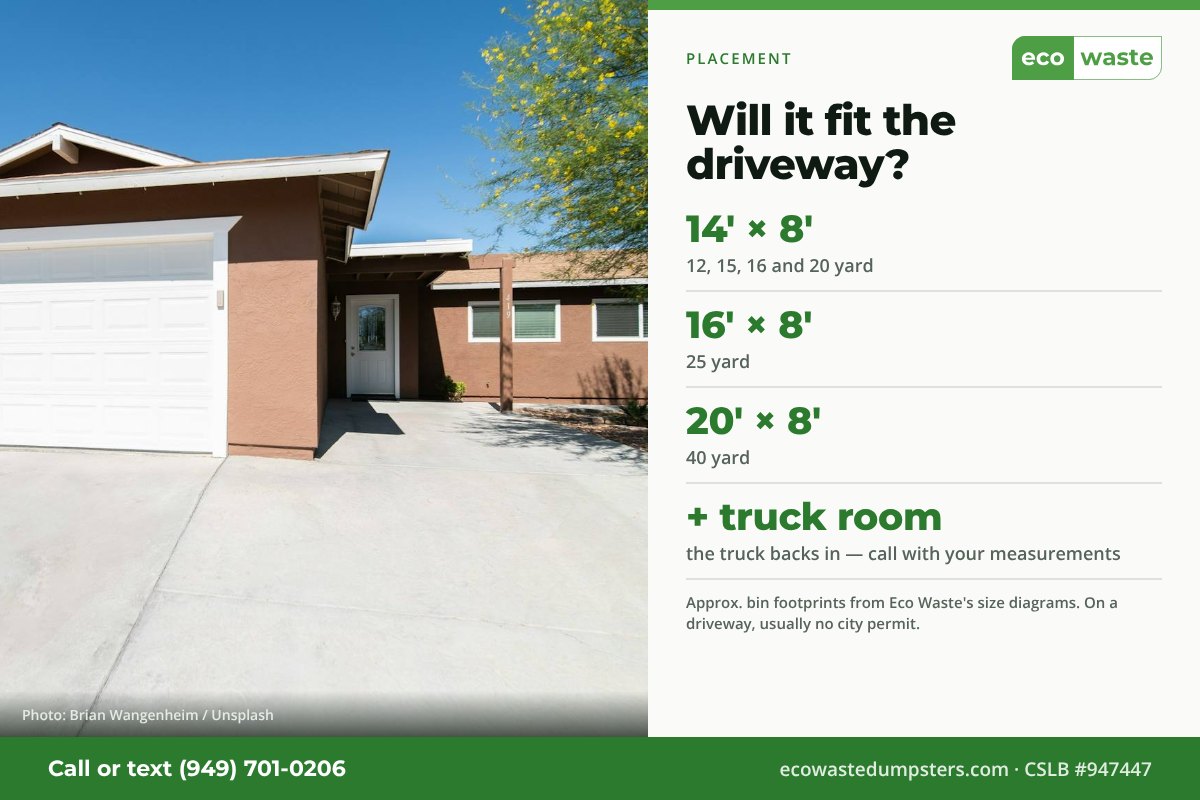
Start with the bin, then add working room. Our bins are all 8 ft wide. The 12, 15, 16 and 20 yard bins are 14 ft long, the 25 is 16 ft and the 40 is 20 ft. A roll-off loads through a rear door, and a door about as wide as the bin needs about 8 ft behind it to swing open. If cars still need to get in and out, leave a lane beside it: Seattle's standard leaves a 10-ft drive aisle beside staged dumpsters.
| Bins | Footprint | Length to open the door | Width with 2 ft to walk | Width with a 10-ft car lane |
|---|---|---|---|---|
| 12, 15, 16, 20 yard | 14 × 8 ft | 22 ft | 10 ft | 20 ft |
| 25 yard | 16 × 8 ft | 24 ft | 10 ft | 20 ft |
| 40 yard | 20 × 8 ft | 28 ft | 10 ft | 20 ft |
Footprints are Eco Waste's outside dimensions. The door, walk and lane allowances are the Driveway Fit Checker's editable assumptions, not rules.
Measure from the garage door, or whatever stops the bin, to the street edge of the driveway, and the width at its narrowest. An 18-ft-wide driveway takes any of our bins with room to walk. It won't also leave a 10-ft lane for cars (that needs about 20 ft), so plan to park on the street while the bin is there.
Check your numbers
The Driveway Fit Checker runs your length, width, overhead, slope and gate against every size and prints the margins. Then call or text us the numbers: the truck figures are industry figures, not our truck.
Overhead clearance: trees, wires and eaves
The bin sits low, but it doesn't arrive low. It comes off the back of the truck tipped up at an angle, so the space overhead matters while it's being set down and picked up, not just where it sits.
| Figure | Height | What it measures |
|---|---|---|
| Hooklift arm, 14-ft bin | 11.9 ft to 13 ft | Stellar 20,000 to 32,000-lb hooklifts, top of the arm's swing while loading |
| Hooklift arm, 20-ft bin | 15.4 ft to 16.6 ft | Same, for bodies of that length |
| Cable hoist, 14-ft container | 15.5 ft to 16.6 ft | Galbreath hoists raised, frame to ground plus height above frame |
| Cable hoist, 20-ft container | 17 ft to 18.6 ft | Same, for containers of that length |
| Seattle Public Utilities | 18 ft | roll-off container not on a dock |
| City of Olympia, WA | 25 ft | loading area for drop boxes |
| NYC Sanitation | 25 ft | rail extension with a 23-ft compactor box |
| City of Edinburg, TX | 30 ft | commercial roll-off service |
Equipment heights are the machine alone at its highest point; the bin on it sits higher. The city figures were written for commercial service with each city's own trucks.
The sources don't agree, and they shouldn't be flattened into one number. They describe different trucks and sites. What they do agree on: a branch at 11 ft over the driveway is lower than every equipment figure we found for our bin lengths, and 18 ft or more (Seattle's figure for a roll-off) clears the manufacturer heights for our 14 and 16-ft bins.
Wires are their own case. California's Title 8 §2946 keeps boom-type lifting or hoisting equipment at least 10 ft from energized lines of 600 to 50,000 volts, and bars operating it over energized high-voltage lines. You can't tell a line's voltage by looking, so tell us about any wire over the spot or the truck's path. Low branches can be trimmed before delivery day. Roof eaves can't, so keep the bin out from under them.

Room for the truck to get in
The truck backs up to the spot in a straight line, sets the bin down behind it, and pulls forward out from under it. So once the bin is down, the whole truck is in front of it. The roll-off trucks in Seattle's, Olympia's and New York City's specs are 35 to 37 ft long.
- Straight run: at least the truck's length in front of the bin. Seattle's standard asks for a 45-ft backing distance; Olympia, Washington's asks for a 60-ft clear area in front of a drop box; Edinburg, Texas, asks 132 ft for commercial service. The street counts, so cars parked across from your driveway can be what stops it.
- Width: Seattle's roll-off truck is 8.5 ft wide, 10.1 ft at the mirrors, and Seattle and Olympia both ask for a 12-ft passage. Measure gates, posts and walls the truck has to back through.
- Turning: Olympia's standard puts it plainly: collection vehicles "need direct and straight access to containers." A driveway that bends, or a spot behind the house, is the hard case.
Slope
Most driveways slope toward the street, and that's usually workable, but the driver needs to know. A roll-off sits on rollers at one end. Olympia, Washington, wants drop boxes on pads of 0.5% or less and requires roll-away protection above that, and Seattle keeps its trucks to grades of 15% or less.
To measure it, lay a 4-ft level along the driveway, lift the low end until the bubble centers, and measure the gap: each inch is about 2.1%. At 5%, the two ends of a 14-ft bin sit 8.4 inches apart. Give us that number when you book.
Protecting the driveway
A loaded roll-off doesn't sit on a flat base. Wastequip's standard containers, for example, ride on two 6 × 2 inch steel tube rails and two 8-inch wheels, so the whole weight comes down on a few narrow strips.
The common fix is boards under the rails: sheets of plywood or lumber laid where the rails and rear wheels will land, so the load spreads out and steel doesn't touch the surface. Some cities require it in the street. Savannah, Georgia, for one, requires 3/4-inch plywood under the runners of a dumpster placed on pavement. We found no Orange County city, manufacturer or hauler association that sets a thickness for driveways, so treat it as common practice, not a guarantee.

Tell us about the surface
If the driveway is pavers, stamped concrete, freshly poured, or already cracked, say so when you book. It changes where the bin should sit, or whether a bag is the better call.
HOA rules and city permits
A bin fully on your driveway is on private property. A bin in the street, on the curb, parkway or sidewalk is in the public right-of-way, and the city decides. Newport Beach, for example, says any dumpster on public property needs a Temporary Street Use Permit, and bins can't go in alleys, red zones or within 15 ft of a street corner.
Check your HOA too. City permits don't cover what an association allows, so ask before delivery day. For your city's rule, use the Dumpster Permit Checker or read Dumpster Permits in Orange County.
Keeping a street bin legal and safe
California law sets markings for bins on the road. Health and Safety Code §26275 requires the owner of a trash receptacle or storage container that sits on a roadway or curb to be emptied or picked up, longer than 3 ft and taller than 4 ft, to mark it with reflectors: at least eight strips of reflective tape, each at least 2 inches wide and 2 ft long, at the corners. It must also carry the owner's name and phone number. That duty falls on the bin's owner.
Cities add their own conditions to the permit. Ojai's roll-off permit, for example, asks for the box within 12 inches of the curb, a 12-ft travel lane left open, and reflectors on all four corners. Orange County cities set theirs on their own permits, so read yours when you get it.