
How heavy is heavy
A cubic yard of remodel debris weighs a few hundred pounds: the EPA puts mixed C&D at 484 lb. A cubic yard of broken concrete is about 5 times that. Here's what the heavy materials weigh loose, as they sit in a bin, and what 10 cubic yards of each comes to.
| Material | lb per loose yd³ | Tons in 10 yd³ | Published range (lb/yd³) | On our rate sheet |
|---|---|---|---|---|
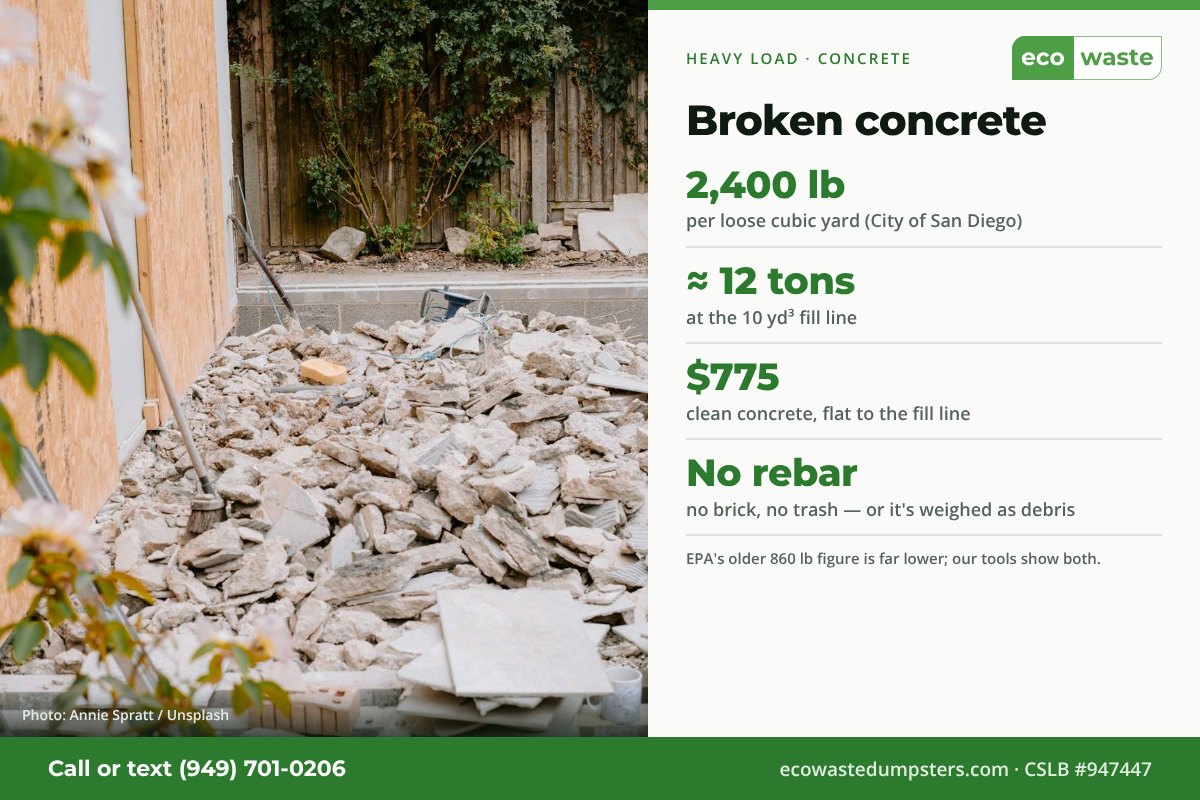
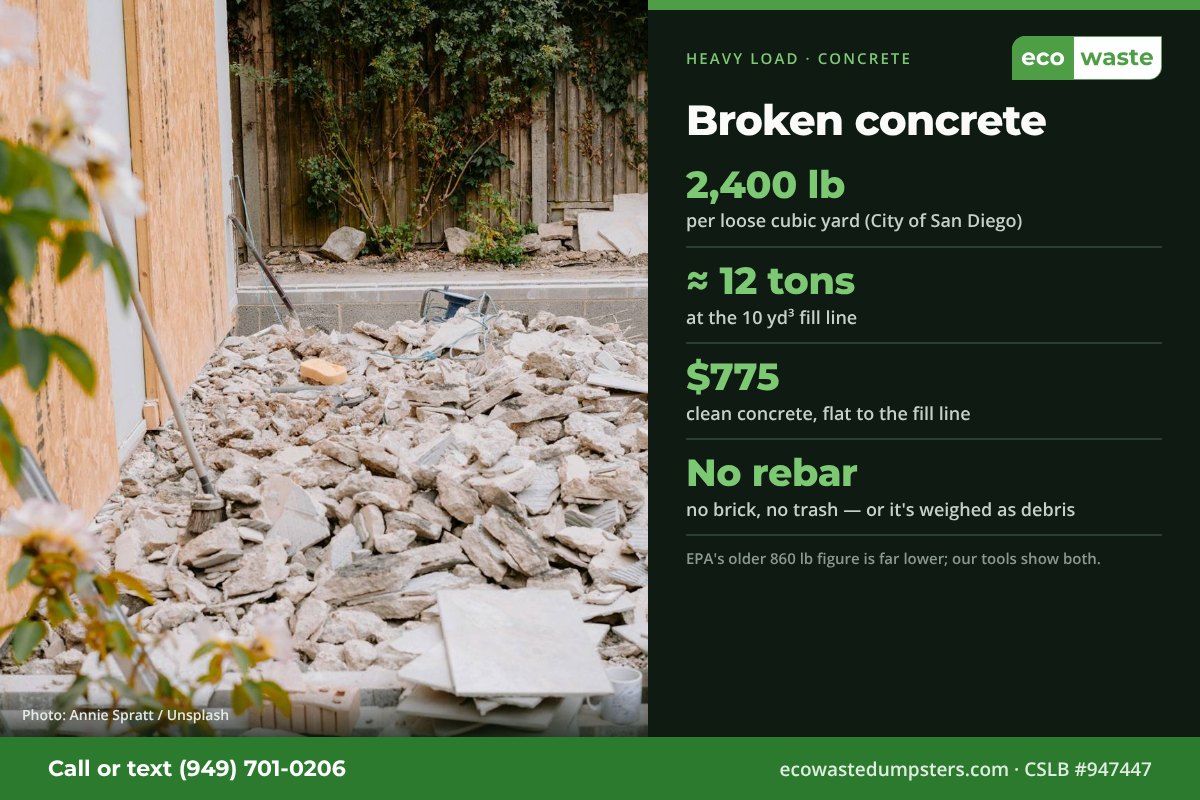
| Concrete, broken | 2,400 | 12 | 860–2,400 | Clean concrete $775 |
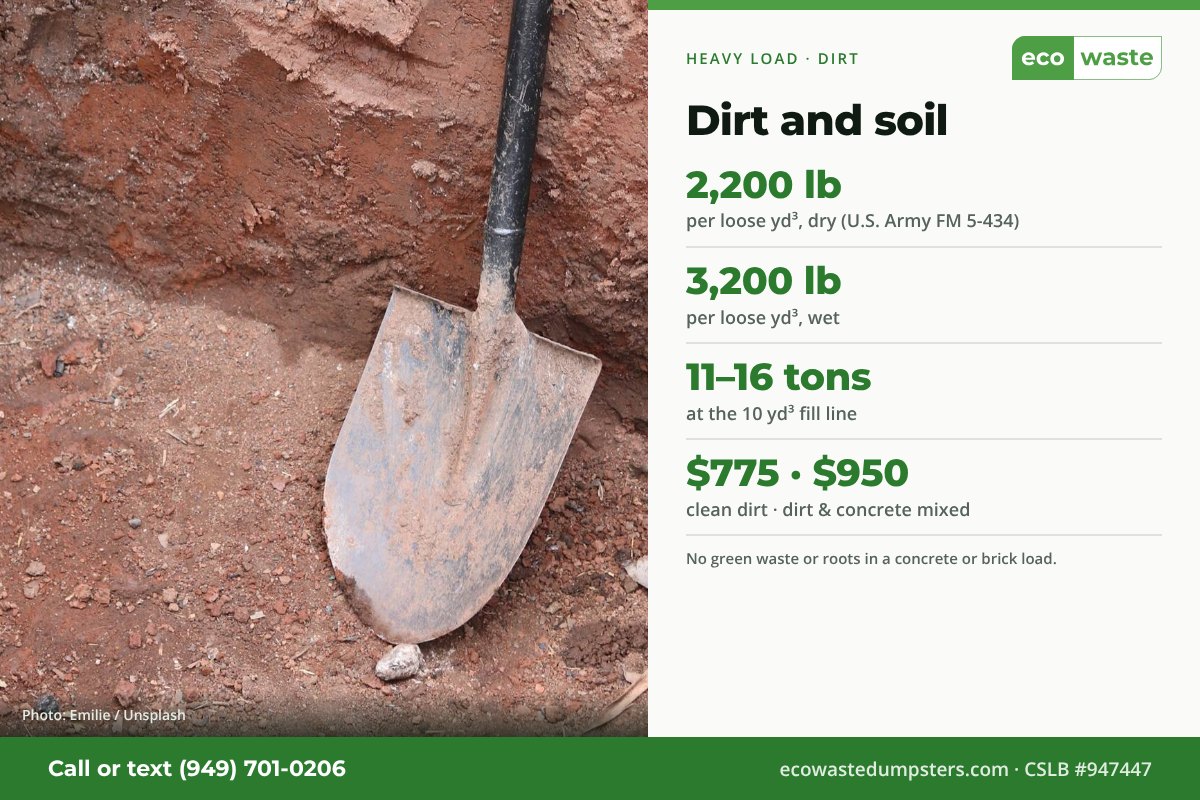
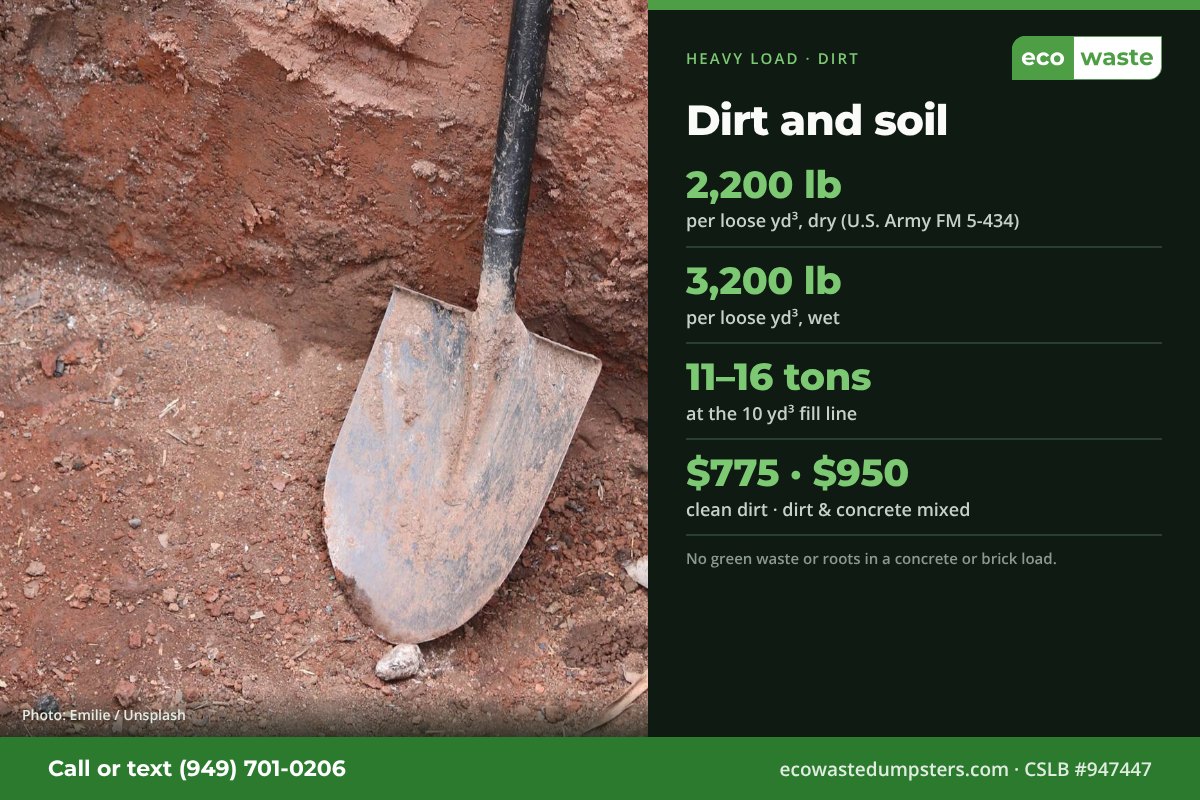
| Dirt / soil, dry | 2,200 | 11 | 929–2,400 | Clean dirt $775 |
| Dirt / soil, wet | 3,200 | 16 | 2,600–3,200 | Clean dirt $775 |
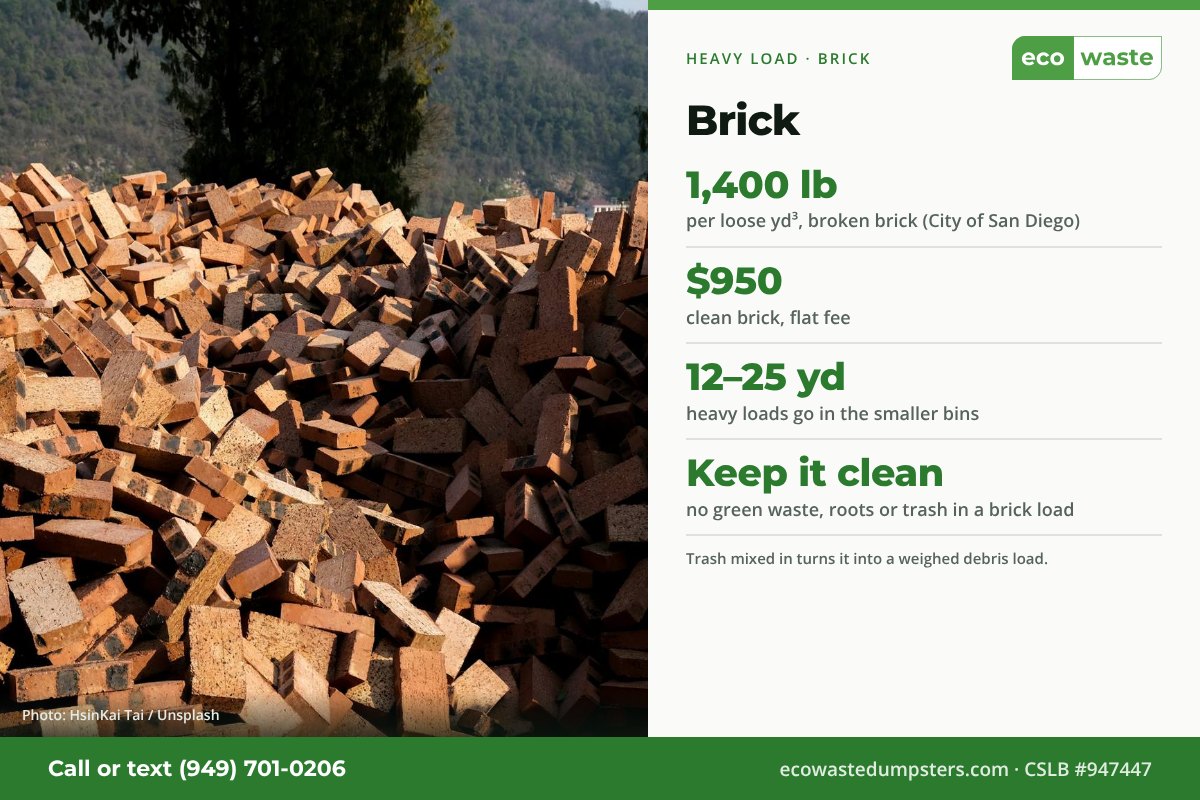
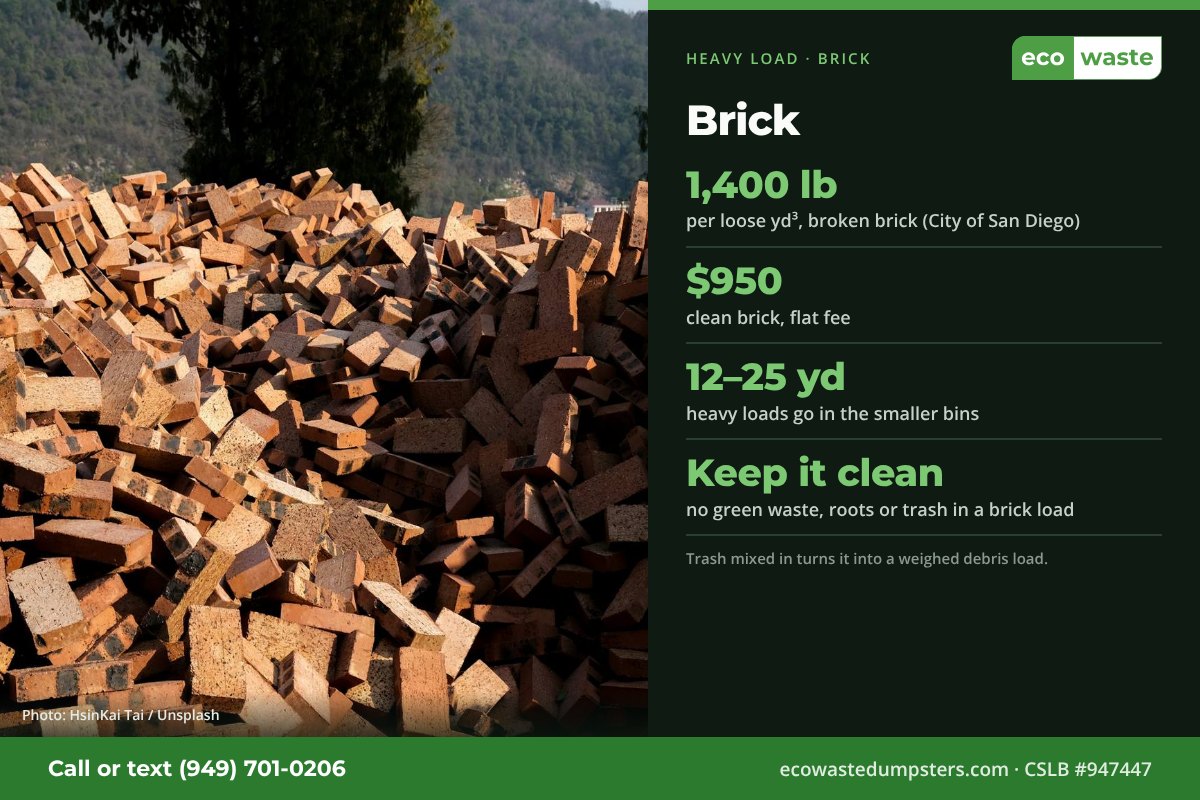
| Brick, broken | 1,400 | 7 | 1,200–3,020 | Clean brick $950 |
| Asphalt paving, broken | 1,400 | 7 | 773–1,400 | Not listed — ask us |
| Sand, dry | 2,900 | 14.5 | 929–2,900 | Not listed — ask us |
| Gravel / rock, dry | 3,000 | 15 | 999–4,700 | Not listed — ask us |
Sources disagree. The EPA's factors for concrete (860 lb) and dirt and sand (929 lb) come from a 2006 California study of mixed C&D loads; for a load of only one material we use the heavier figures from the City of San Diego and the U.S. Army. Full comparison: debris weight calculator.
Minnesota's 2021 study, which weighed loaded trucks, measured mixed concrete-and-dirt loads at an average of 1,453 lb per cubic yard (median 1,308). That's lighter than a bin of pure broken concrete, and still about 3 times the EPA's figure for mixed C&D.
Why heavy loads stop at a fill line
The arithmetic shows the problem. A 20-yard filled to the top with broken concrete would hold about 48,000 lb (24 tons) of concrete alone, before the steel bin and the truck are counted.
California law caps what a vehicle can put on the road. Vehicle Code §35550(a): "The gross weight imposed upon the highway by the wheels on any one axle of a vehicle shall not exceed 20,000 pounds." §35551 then limits any group of two or more consecutive axles by how far apart they are, and Caltrans lists 80,000 lb as the gross limit for a vehicle combination. At 48,000 lb, that full 20-yard of concrete is more than two axles' worth of the 20,000 lb single-axle limit before anything else is counted.
Our rule
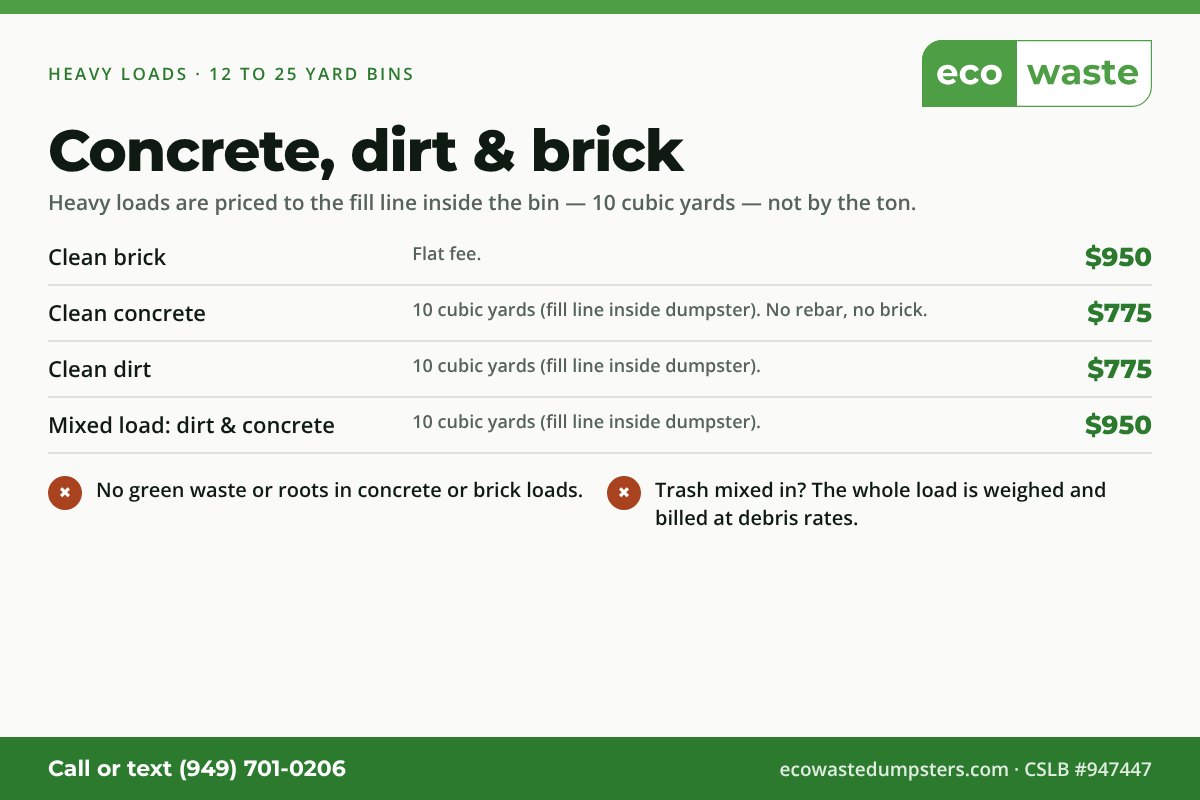
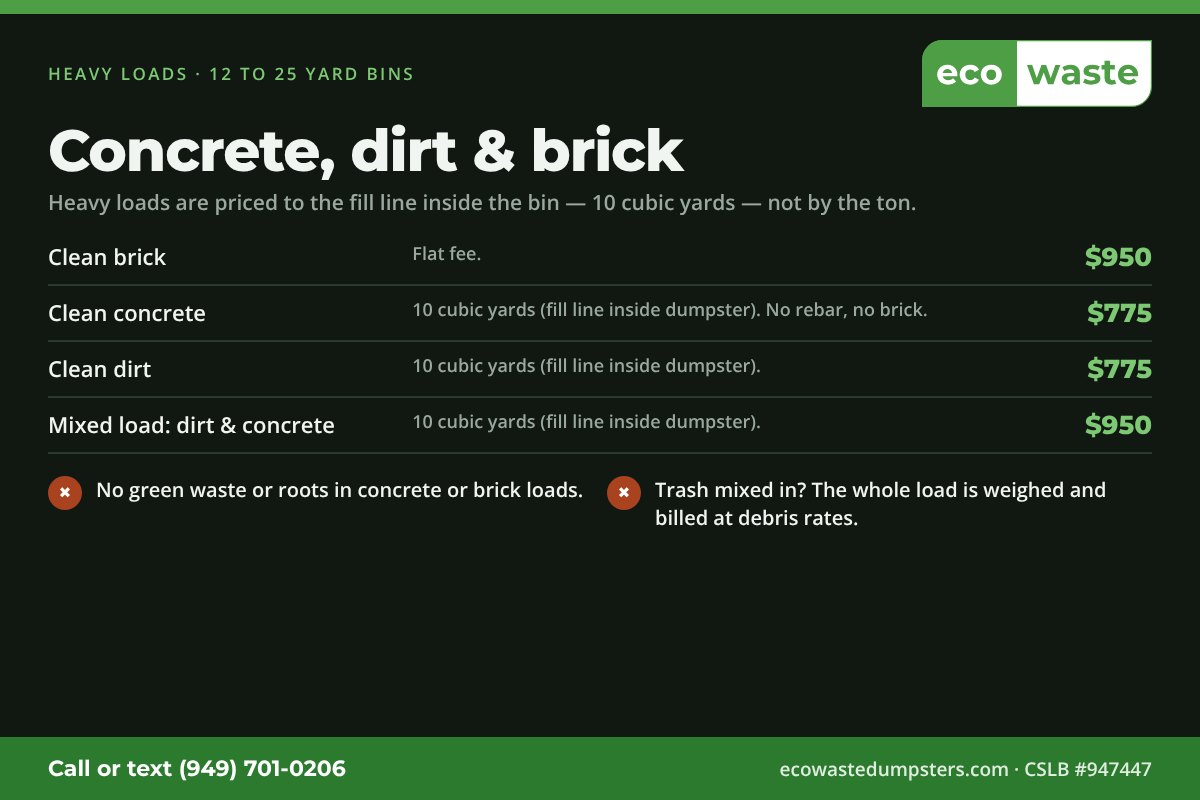
Clean concrete, clean dirt and mixed dirt and concrete go to the 10 cubic yard fill line inside the dumpster, in the rate sheet's words. Load to the line, not to the top. Heavy loads are priced for our 12 to 25-yard bins; the 40-yard is listed for debris, trash, green waste only.
What "clean" means
The flat rates are for clean loads. The rate sheet spells out what breaks that:
- Clean concrete: "10 cubic yards (fill line inside dumpster). No rebar, no brick."
- Green waste and roots: "Absolutely no green waste or roots in loads designated for only concrete or brick."
- Trash: "Any debris/trash combined in a dumpster with dirt, concrete, brick or green waste will be weighed and billed at debris/trash rates."
- Mixed loads: "All mixed loads are dumped at the landfill and charged by weight."
| Load | Price | How it's billed |
|---|---|---|
| Clean brick | $950 | Flat fee. |
| Clean concrete | $775 | 10 cubic yards (fill line inside dumpster). No rebar, no brick. |
| Clean dirt | $775 | 10 cubic yards (fill line inside dumpster). |
| Mixed load: dirt & concrete | $950 | 10 cubic yards (fill line inside dumpster). |
Rental is 14 days. Prices from our rate sheet.
Rebar and wire mesh: the clean-concrete rate says no rebar, so if your slab has steel in it, call or text before you load it.
What mixing costs
Take one bin of broken concrete to the fill line: 10 yd³, about 12 tons. Clean, it's $775. Put trash in it and it's weighed at debris rates. Counting only the concrete's weight, that's $650 with 3 tons included, then 9 extra tons × $135: $1,865.
Keep a second bin or a bag for the trash
The difference in that example is $1,090. A $775 clean concrete bin plus a separate debris bin, or a Dumpster Bag for the small stuff, keeps the heavy load on its flat rate.
Estimating your slab or dig
Weight comes from the size in place. Concrete is about 150 lb per cubic foot (Portland Cement Association design density), so a 4-inch slab is about 50 lb per square foot. Broken up, it takes more room: we use 1.69× (solid 4,050 lb ÷ broken 2,400 lb per cubic yard). The U.S. Army's figure for broken trap rock is 50% swell (1.5×). The two disagree, so the calculator lets you change it.
| What | Square feet per bin | Tons per bin |
|---|---|---|
| Concrete slab, 4 in | 480 | 12 |
| Concrete slab, 6 in | 320 | 12 |
| Dry dirt, dug 6 in deep | 399 | 11 |
| Dry dirt, dug 12 in deep | 199 | 11 |
| Wet dirt, dug 12 in deep | 216 | 16 |
Dirt swell is the U.S. Army's bank-to-loose ratio: 1.35× for dry earth (its range is 15–35%), 1.25× for wet. Dry dirt in the ground: 2,980 lb per cubic yard; loose: 2,200.
The concrete & dirt calculator does this for every slab and dig on your job, prices separate and mixed bins, and shows the cheaper one.
Brick, and the heavy materials we don't list
Clean brick is $950 flat. The rate sheet doesn't print a fill line for brick, so ask us how much a bin can take. Broken brick is about 1,400 lb per loose cubic yard (City of San Diego); whole, palletized brick is about 3,020 lb.
Sand, gravel, rock and asphalt aren't on our rate sheet. They're heavy too. The Army puts loose dry gravel at 2,700–3,000 lb a cubic yard, and San Diego puts broken asphalt at 1,400. Call or text before you load them.