
The short version
- Green waste is priced like debris: $650 with 3 tons in the 12 to 25-yard bins, $825 with 5 tons in the 40, $135 for each ton over, rounded to the nearest ton.
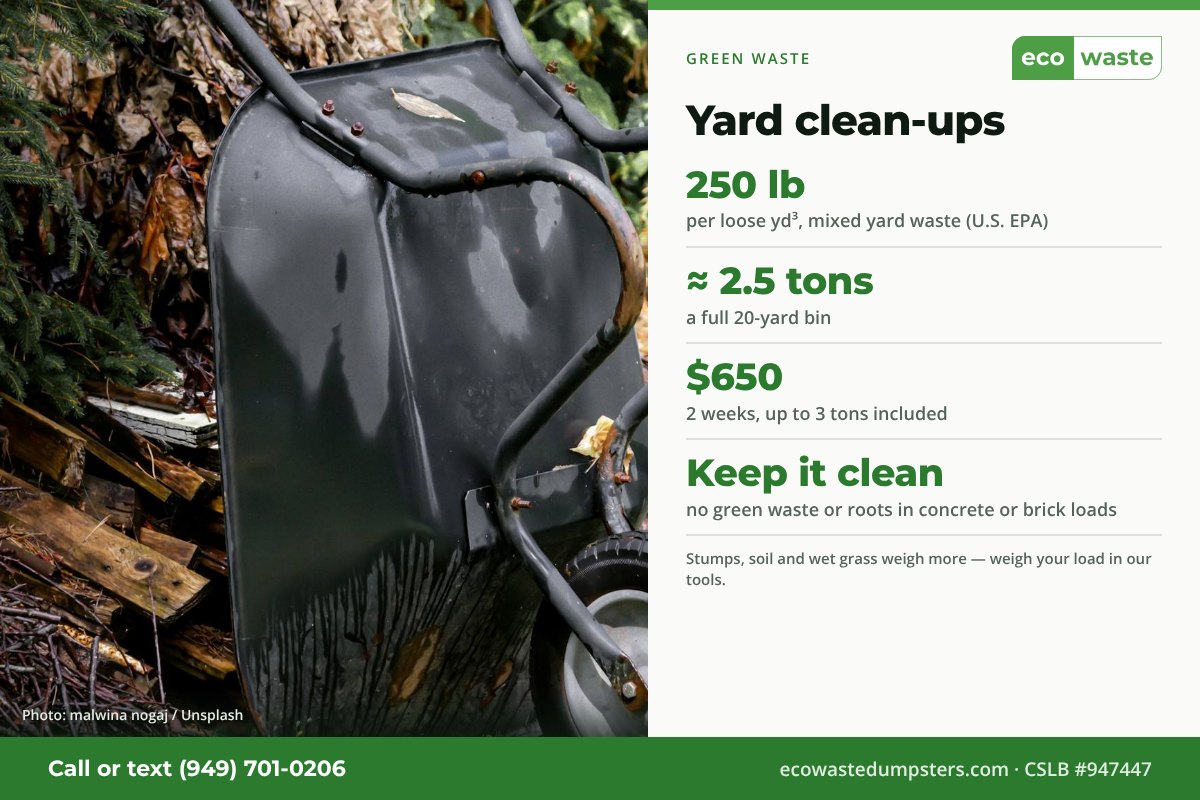
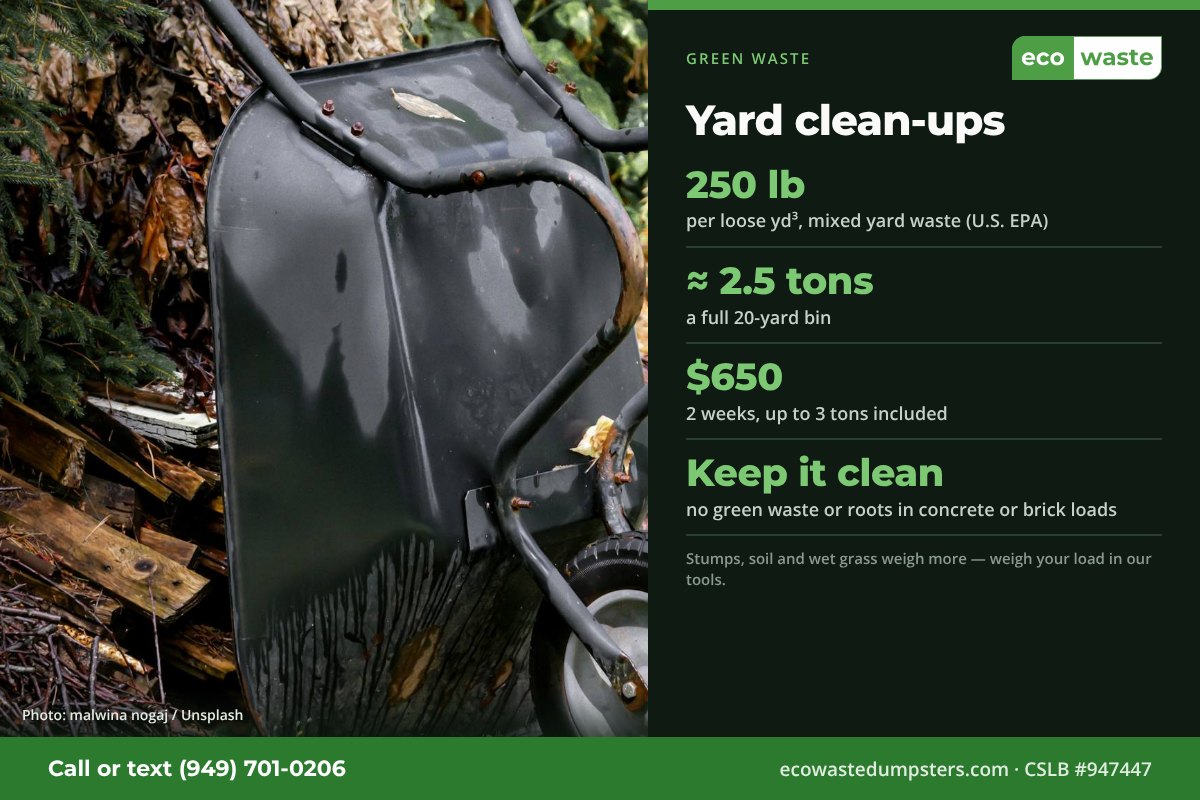
- It's light. At 250 lb per loose cubic yard, a 16-yard bin of yard waste is about 2.0 tons. Loose mixed yard waste alone would take about 28 cubic yards to pass the 3 tons included, more than a 25-yard holds.
- Soil and roots are heavy. Loose dry dirt is about 2,200 lb a cubic yard and wet dirt 3,200. Shake it off before it goes in.
- The rule on our rate sheet: "Absolutely no green waste or roots in loads designated for only concrete or brick."
- SB 1383 makes cities give every home and business an organics service and makes haulers take organic waste to a facility that recovers it. A homeowner complies by using the city's organics service or by self-hauling to a facility that processes or recovers organic waste.
What counts as green waste
California's regulations define the pieces. Title 14 of the California Code of Regulations, section 17852, defines yard trimmings as "any wastes generated from the maintenance or alteration of public, commercial or residential landscapes including, but is not limited to, yard clippings, leaves, tree trimmings, prunings, brush, and weeds."
The same section defines green material as plant material, other than food, "that is separated at the point of generation" and "contains no greater than 1.0 percent of physical contaminants by dry weight." That's the standard a composter works to: plant material, kept separate, with almost nothing else in it.
SB 1383's regulations use a broader term, organic waste (14 CCR 18982): "food, green material, landscape and pruning waste, organic textiles and carpets, lumber, wood, paper products" and more. So lumber is organic waste under SB 1383 but is not green waste on a dumpster rate sheet.
| Material | Named in the yard trimmings definition? | What to know |
|---|---|---|
| Grass clippings, leaves, weeds | Yes | Light: fills a bin by volume long before weight |
| Tree trimmings, prunings, brush | Yes | Bulky; cut long limbs so they lie flat below the red line |
| Stumps and root balls | Not by name | Ask us before loading; the soil on them is weighed with the load |
| Sod and dirt | No | Ask us before loading; soil weighs about nine times what loose yard waste does |
| Lumber, fence boards, pallets | No | Organic waste under SB 1383, but not landscape waste |
| Rocks, pavers, brick, concrete edging | No | Heavy; and a concrete or brick load can't contain green waste or roots |
| Bagged trash, plastic pots, irrigation pipe | No | Debris; mixed in, the load is billed at the debris rate |
Our rate sheet names "green waste" as a load type without listing what's in it, so ask us about stumps and sod. The debris and green waste rates are the same price in our bins, so mixing mostly costs you through weight. The rule: "Any debris/trash combined in a dumpster with dirt, concrete, brick or green waste will be weighed and billed at debris/trash rates."
Our green waste rules
| Bin | Price | Included | Rate sheet note |
|---|---|---|---|
| 12, 15, 16, 20 or 25 yard, green waste | $650 | 3 tons | 3 tons & under. $135 each additional ton. |
| 40 yard, debris, trash, green waste | $825 | 5 tons | 5 tons & under. $135 each additional ton — landfill. |
Extra tonnage is rounded to the nearest ton. 2-week rental; $15.00 for each additional day unless other arrangements have been made.
No green waste or roots in concrete or brick loads
Clean concrete and clean brick have flat prices on our rate sheet. That price holds only if the load is only concrete or only brick. The rule is word for word: "Absolutely no green waste or roots in loads designated for only concrete or brick." Pulling out a planter or a lawn edged in brick? Separate the roots and soil from the masonry, or plan on two loads.
If debris goes in with green waste, "any debris/trash combined in a dumpster with dirt, concrete, brick or green waste will be weighed and billed at debris/trash rates." In a green waste bin that's the same $650 and 3 tons, so the practical cost of mixing is the weight you add.
Why soil and roots change the bill
Plant material is mostly air when it's loose in a bin. Soil isn't. The weights below are the ones our debris weight calculator uses, per loose cubic yard.
| Material | lb per cubic yard | Tons in 10 cubic yards | Which figure |
|---|---|---|---|
| Grass clippings / garden waste | 233 | 1.17 | Minnesota PCA’s measured average (EPA lists no grass factor). |
| Mixed yard waste, loose | 250 | 1.25 | EPA’s factor for uncompacted mixed yard waste (EPA gives 640 lb once compacted). |
| Branches, brush and stumps | 127 | 0.64 | EPA’s factor for branches & stumps (same as prunings & trimmings). |
| Leaves | 500 | 2.50 | High end of EPA’s 250–500 lb. Minnesota measured leaves at 80 lb. |
| Wood chips / chipped green waste | 473 | 2.37 | EPA’s factor for green wood chips (dry chips: 243 lb). |
| Dirt / soil, dry | 2,200 | 11.00 | High end of the U.S. Army’s 1,900–2,200 lb for loose dry earth. EPA’s 929 lb (dirt and sand) comes from the same 2006 study of mixed C&D loads. |
| Dirt / soil, wet | 3,200 | 16.00 | High end of the U.S. Army’s 2,800–3,200 lb for loose wet earth. |
Worked example, a 16-yard bin. Fourteen cubic yards of loose yard waste is 3,500 lb, 1.75 tons: $650, inside the 3 tons. Add 2 cubic yards of dry soil clinging to roots and stumps (4,400 lb) and it's 3.95 tons: $785. If that soil is wet (6,400 lb), it's 4.95 tons: $920. The bin looks the same in all three.
- Knock soil off root balls and sod before they go in.
- Let wet material dry if you can. Water is weight.
- Keep rock, brick and concrete out of a green waste load, and green waste out of theirs.
- Price it in the dumpster cost calculator, with the tons from the debris weight calculator.
SB 1383: what it requires, and of whom
SB 1383 (Lara, 2016) is California's short-lived climate pollutant law. CalRecycle describes its two 2025 targets: 75% less organic waste sent to landfills and 20% of unsold, still-edible food recovered for people to eat. The regulations are in Title 14, Chapter 12, and most duties fall on cities, counties and haulers.
| Who | What the regulation requires | Section |
|---|---|---|
| Residents and businesses (generators) | Either subscribe to and follow the city's organic waste collection service, or self-haul organic waste as Article 7 allows | 14 CCR 18984.9(a) |
| Businesses, in addition | Provide organics and recycling containers wherever disposal containers are provided for customers (restrooms excepted); prohibit employees from putting organic waste in the wrong container; periodically inspect for contamination | 14 CCR 18984.9(b) |
| Self-haulers | Take source-separated organic waste to a facility that processes or recovers it; keep delivery receipts and weight tickets. A residential self-hauler doesn't have to record or report | 14 CCR 18988.3 |
| Haulers | Take organic waste they collect to a facility that recovers organic waste, with the jurisdiction's approval. Doesn't apply to a hauler lawfully moving construction and demolition debris under the CALGreen section | 14 CCR 18988.1, 18988.2 |
| Cities and counties | Provide organic waste collection to every home and business (from January 1, 2022, per CalRecycle); in a three-container system, the green container is for organic waste such as yard trimmings and food; adopt CALGreen's recycling and C&D sections by ordinance | 14 CCR 18984.1, 18989.1 |
What that means for your yard clean-up
Nothing in the sections above sets a price for a yard waste bin or stops you renting one. What they ask of a homeowner is simple: put organics in the city's organics service, or self-haul them to a place that processes or recovers them. Construction and demolition debris runs under CALGreen instead; see C&D recycling rules in California.
Orange County's landfills add their own rules for self-haulers: only Prima Deshecha and Olinda Alpha take the public, and a clean soil load over 5 cubic yards or 8 tons needs the county's soil form and testing. If you're thinking of hauling it yourself, the dump run calculator compares it with a bin.